How Coal Mining Pollution Affects Ecosystems and the First Nations Community
ByCoal mining is the process of collecting coal from the ground. It has been used for energy and to generate electricity since the 1880s. Although coal mining provides great resources, there are many harmful effects on ecosystems. The coal mining industry and the government together are responsible for the damage.
The pollution created from coal mining can affect aquatic, forest, human ecosystems and more. The aquatic ecosystem is affected by pollution in the water as it can cause acidic pH in the water. The forest ecosystem is affected by pollution as trees and soil can be damaged from increased levels of nitrogen. The biodiversity of plants and fish can be reduced from the effects of increased atmospheric nitrogen. Human ecosystems can also be affected by the pollution caused in aquatic and forest ecosystems as we consume resources from both ecosystems. Coal mining produces carbon dioxide which can contribute to global warming. In the pie graph below, coal mining makes up 32% of the carbon dioxide emissions in the atmosphere that impact global warming.
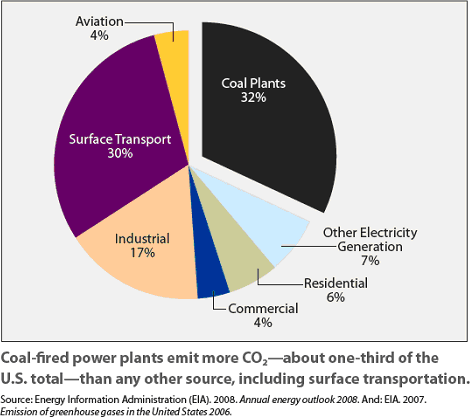
https://www.ucsusa.org/resources/coal-and-air-pollution.
There are a large amount of chemicals produced during coal mining that cause pollution. The table below shows plenty of examples of harmful compounds released during coal mining.
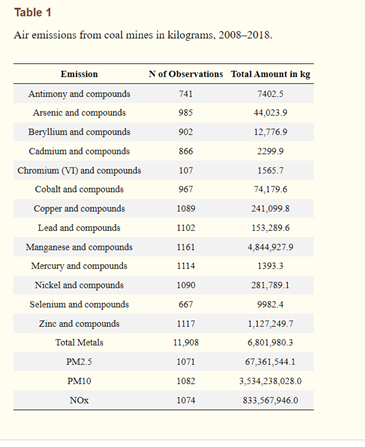
Source: Hendryx, M., Islam, M. S., Dong, G.-H., & Paul, G. (2020, February 29). Air Pollution Emissions 2008-2018 from Australian Coal Mining: Implications for Public and Occupational Health. International journal of environmental research and public health. https://www.ncbi.nlm.nih.gov/pmc/articles/PMC7084742/.
Short term effects include removal of vegetation in the area and distortion of topography. Long term effects of coal mining include erosion, deforestation, loss of biodiversity, acidic drainage, and contamination of soil and water. All of these effects can lead to health issues. coal mining produces air and water pollution which effects breathing and can harm a lot of living organisms. Coal mining pollution can also cause cancer, premature death, heart attacks and many other serious health problems. Coal mines are responsible for 42% of mercury emissions in the US, which is a toxic heavy metal that can cause nervous, digestive, and immune system damage (Union of Concerned Scientists Staff, 2008).
Coal mining affects the health and environment of the First Nations community. For example, coal mining in British Columbia has decreased wildlife in their territory due to noise and deforestation (West Coast Environmental Law Staff, 2011). The animals that remain in the territory may be affected by the pollution. Animals provide a major source of food for First Nations, and the lack of animals to hunt has caused some members of the community to change their diets. Hunting is also a major part of their culture. Due to the negative impact on the environment from coal mining, First Nations are unable to fully enjoy their culture.
Alberta First Nations have written letters to coal farming companies that state that they will oppose any new coal mine proposals as the provincial government ignored their concerns. The Siksika and Kaini of the First Nations have stated that new mines would threaten one of the areas that can still support Blackfoot culture. These two First Nations make up about 70% of the Treaty 7 population (Canadian Press, 2021). This is a huge population of First Nations people that would be negatively impacted by coal mining.
Coal mining conflicts with Indigenous views of sustainability as it does not maintain a balance between human beings and the environment. The indigenous community focuses on preserving the natural world for future generations. However, if coal mining continues and produces the same amount of pollution, then this will have a huge impact on sustainability.
Reference List
Brown, M. (2019, September 24). Pollution found in U.S. river downstream of Canadian mines. CTVNews. https://www.ctvnews.ca/sci-tech/pollution-found-in-u-s-river-downstream-of-canadian-mines-1.4606954.
Canadian Press. (2021, February 24). ‘Serious concerns’: Alberta First Nations oppose coal expansion in Rocky Mountains | CBC News. CBCnews. https://www.cbc.ca/news/canada/calgary/alberta-first-nations-coal-policy-1.5926902.
Coal and Air Pollution. Union of Concerned Scientists. (2008, July 28).
https://www.ucsusa.org/resources/coal-and-air-pollution.
Viewing mining’s effects on First Nations through the lens of Aboriginal Rights. West Coast Environmental Law. (2011, October 30). https://www.wcel.org/blog/viewing-minings-effects-first-nations-through-lens-aboriginal-rights.
Source: Hendryx, M., Islam, M. S., Dong, G.-H., & Paul, G. (2020, February 29). Air Pollution Emissions 2008-2018 from Australian Coal Mining: Implications for Public and Occupational Health. International journal of environmental research and public health. https://www.ncbi.nlm.nih.gov/pmc/articles/PMC7084742/.